
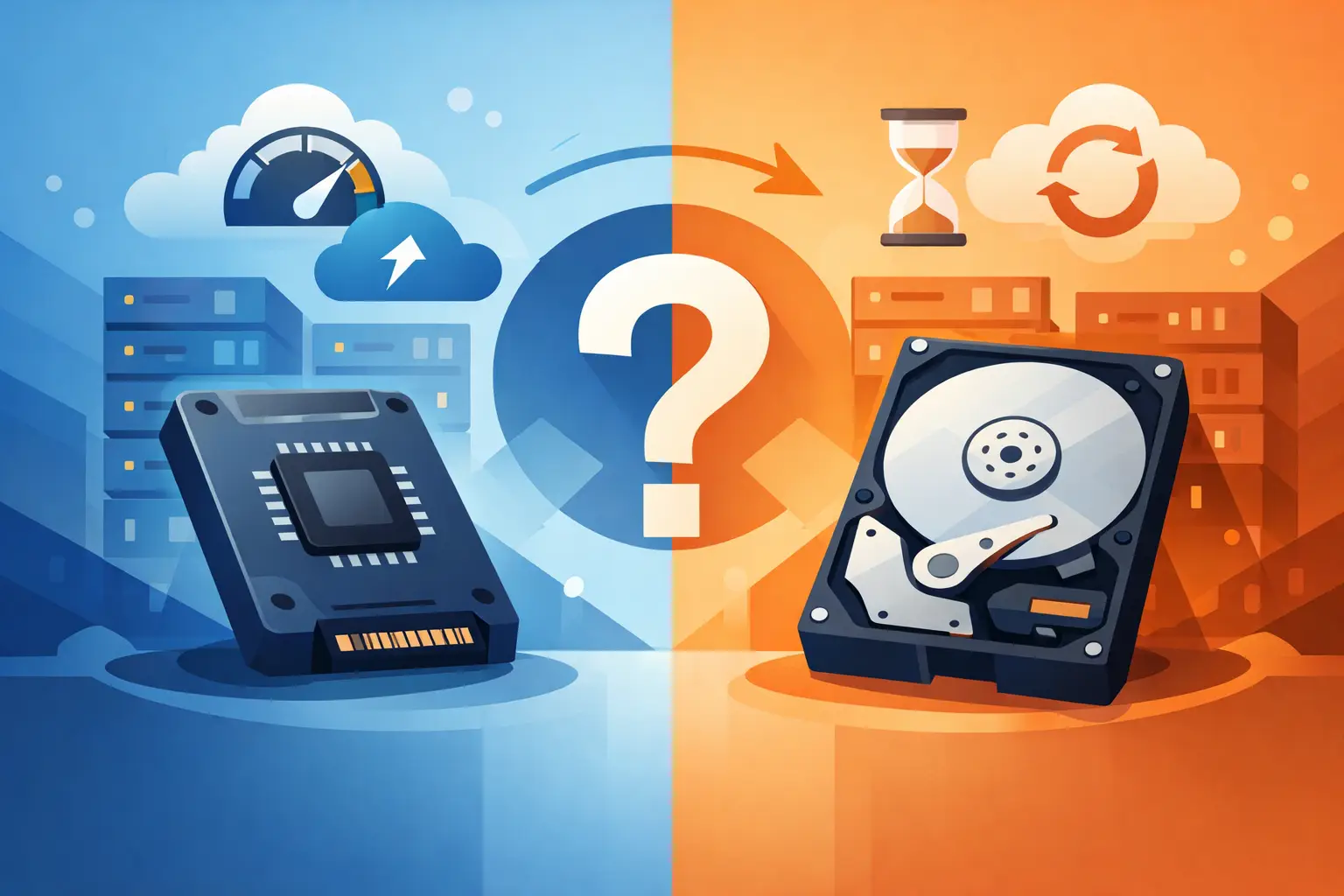
A slow website usually does not fail all at once. It starts with small delays – a page that takes a little too long to load, a checkout that hesitates, a dashboard that feels sluggish at busy hours. When people compare ssd hosting vs hdd, that is the real issue they are trying to solve: how quickly and reliably their website can respond when visitors show up.
For most small businesses, bloggers, and first-time site owners, the answer is simpler than it used to be. SSD hosting is usually the better choice because it is faster, more consistent, and better suited to modern websites. HDD hosting can still work for some low-demand projects, but the trade-off is performance.
What ssd hosting vs hdd really means
The difference comes down to the type of storage used on the server that hosts your website.
HDD stands for hard disk drive. It stores data on spinning disks and uses mechanical parts to read and write information. This is older technology, and while it has been widely used for years, it is slower by design because physical components have to move.
SSD stands for solid-state drive. It stores data on flash memory and has no moving parts. That allows it to access files much faster and with less delay. In hosting, that speed can affect how quickly your website loads files, databases, images, and scripts.
If your site runs WordPress, uses cPanel, relies on a database, or handles regular visitor traffic, storage speed is not just a technical detail. It affects the experience your visitors have every time they open a page.
Why SSD hosting usually feels faster
Most websites are made up of many small pieces. A single page might pull theme files, plugin files, images, CSS, JavaScript, and database content before it fully loads. The faster the server can retrieve those files, the faster your site can start building the page for the visitor.
This is where SSD hosting has a clear advantage. SSDs are better at handling the frequent read and write tasks that happen on busy hosting servers. That matters when multiple websites are sharing the same infrastructure, which is common in affordable shared hosting.
In practical terms, SSD hosting often helps with faster page load times, quicker admin panel access, smoother WordPress performance, and better responsiveness during traffic spikes. Visitors may not know why your site feels better, but they notice when it does.
That said, storage is only one part of hosting speed. Server configuration, available resources, caching, software setup, and network quality also matter. An SSD plan on a poorly managed server will not magically fix every performance issue. But when all else is reasonably equal, SSD hosting gives you a stronger starting point.
SSD hosting vs HDD for reliability
Speed gets most of the attention, but reliability matters just as much.
Because HDDs rely on moving mechanical parts, they are more vulnerable to wear over time. SSDs have no spinning disks or read heads, which generally makes them more durable in day-to-day hosting environments. For a website owner, that can mean more stable performance and fewer storage-related slowdowns.
This does not mean every HDD server is unreliable or every SSD server is perfect. Hosting quality still depends on the provider, its maintenance practices, backup systems, monitoring, and support. But if you are comparing the storage technology alone, SSDs are typically the more dependable option for modern hosting.
That is especially relevant for small business websites. If your site supports leads, appointments, contact forms, or sales, even short periods of poor performance can cost you opportunities. Reliability is not just about whether the server stays online. It is also about whether it stays responsive.
Where HDD hosting still makes sense
HDD hosting is not useless. It is simply less attractive for most active websites today.
If you are hosting a very basic site with minimal traffic, or storing large amounts of archive data where speed is not a big concern, HDD-based infrastructure can still be functional. Some providers may also offer lower-cost storage options using HDDs for backup-heavy environments or budget plans.
The question is whether the savings are worth it. For many site owners, the price gap between SSD and HDD hosting is no longer large enough to justify the slower performance. If your website is important enough to represent your business, portfolio, or brand, cutting corners on storage is usually not where you want to save money.
This is one of those cases where cheap can become expensive. A lower monthly bill may look good at first, but if your site feels slow, loses visitors, or creates extra frustration in day-to-day use, the real cost shows up elsewhere.
How SSD hosting helps WordPress and cPanel users
Many small websites run on WordPress and are managed through cPanel. In that setup, SSD hosting tends to be a better fit.
WordPress depends heavily on database calls and frequent file access. Every plugin, theme setting, and content request adds more work for the server. Faster storage helps reduce lag in both the front end and the admin area. You may notice quicker post editing, faster media uploads, and a more responsive dashboard.
cPanel users also benefit from faster storage when managing emails, files, backups, and databases. These tasks may seem minor on their own, but over time they shape how easy your hosting account feels to use.
For beginners, this matters more than they may expect. A hosting environment that responds quickly is easier to manage, less frustrating, and more confidence-building. When setup is already new territory, simple things like fast file manager access or smooth one-click installs make a difference.
SSD hosting vs HDD and SEO
Website speed is not the only SEO factor, but it does affect user experience, and user experience affects results.
A faster site can help reduce bounce rates, keep visitors engaged longer, and support better mobile usability. Search engines also consider page performance as part of the bigger quality picture. That does not mean switching from HDD to SSD will suddenly send your site to the top of search rankings. It means better hosting removes one common obstacle.
If your pages load slowly before visitors can even read your content, your SEO efforts have to work harder. Good hosting gives your website a fair chance to perform.
For businesses investing in content, local visibility, or online sales, SSD hosting is usually the smarter base to build on.
What matters more than the storage label
It is easy to focus only on SSD vs HDD, but hosting decisions should not stop there.
A reliable host should also give you stable uptime, support that answers when you need help, free SSL, simple software installation, and clear account management. If you are a small business owner or first-time site creator, support and usability often matter just as much as raw specs.
That is why the best hosting choice is not just the fastest drive on paper. It is the plan that combines good hardware with a dependable support team and a setup you can actually manage.
For example, SSD hosting paired with cPanel, one-click app installs, backups, and responsive technical support is far more useful than a confusing high-performance setup you cannot maintain. Practical reliability wins.
Which should you choose?
If you are launching a business website, blog, portfolio, or online store, choose SSD hosting in almost every case. It is better suited to modern websites, gives you stronger day-to-day performance, and helps reduce one of the most common causes of poor user experience.
If your site is extremely simple, rarely updated, and you are choosing between two plans based only on cost, HDD hosting may still work. But that is becoming the exception, not the rule.
For most people, the real comparison is not between two equal options. It is between older storage technology and the standard that has largely replaced it. SSD hosting is faster, more responsive, and generally a better value for active websites.
That is why many modern hosting providers, including Visiba, build their shared hosting around SSD infrastructure rather than treating it as a premium extra. It matches what site owners actually need: speed, stability, and fewer technical headaches.
When you are choosing hosting, think less about jargon and more about the experience you want for your visitors and for yourself. If you want a website that loads quickly, feels dependable, and is easier to manage over time, SSD hosting is usually the better call.